Showing posts with label Avison. Show all posts

Tuesday, May 17, 2011

Avison: 12 Concerti Grossi - Brandenburg Consort, Goodman

Charles Avison
12 Concerti Grossi after Sonatas by Domenico Scarlatti
The Brandenburg Consort, Roy Goodman
Hyperion CDA66891-2

In the days before composers were protected by copyright laws, publishers, players, and other composers could steal whatever music they liked and pass it off as their own. Some of them, however, were slightly more honest, and others, like Avison, both honest and commercially astute. Scarlatti's 30 keyboard sonatas created a sensation when they were published in England. So Avison took them and arranged them as concertos for strings, thereby bringing the music to a wider public. In making these arrangements, Avison completely recomposed much of the music, adding his own ideas where necessary to create a balanced concerto form. The result is a fresh, entertaining collection, vivaciously performed here on "authentic" instruments.

David Hurwitz, Amazon Editorial Review

Monday, May 9, 2011

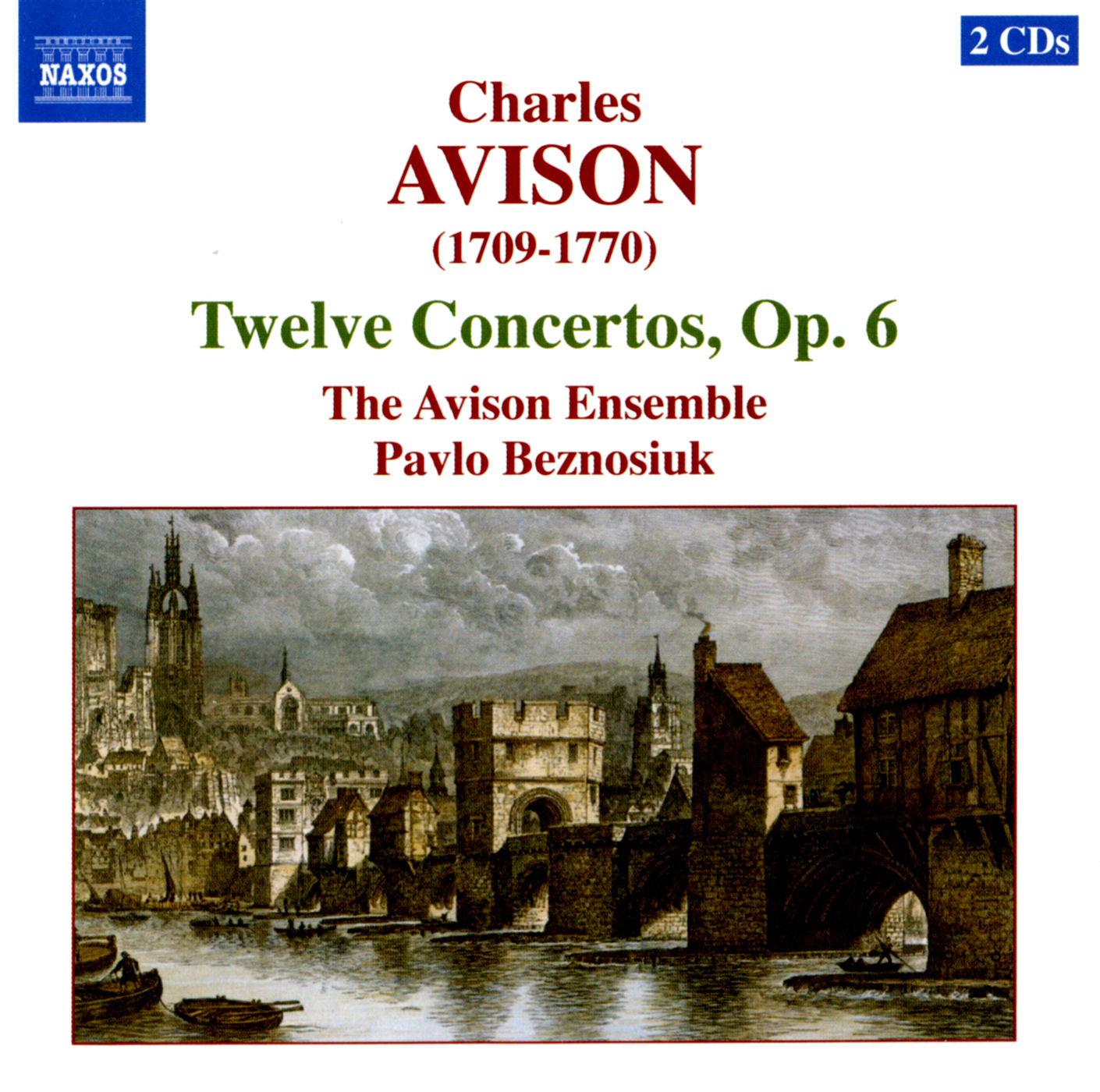
Avison: Twelve Concertos Op.6 - The Avison Ensemble, Beznosiuk

Charles Avison
Twelve Concertos Op.6
The Avison Ensemble, Pavlo Beznosiuk
Naxos 8.557553-54

Avison’s ability to pattern his works on the music of others stood him in good stead throughout his career While he was a fine musical craftsman, his own creative powers seem to be more limited. His concertos are skillfully fashioned, have plenty of vitality and show perceptive use of dynamic contrast; but the music itself, finely wrought as it is, displays no special melodic individuality or any unconventional features. Played as vibrantly and freshly as it is here, on period instruments by this expert ensemble from Avison’s own city, and led by the excellent violinist Pavlo Beznosiuk, one cannot help but respond to the vitality of the writing, even if these concertos are not in the same league as the similar works by Corelli or Handel.

The Penguin Guide to Recorded Classical Music 2010

Sunday, May 8, 2011

Avison: Six Concertos Op.3, Eight Concertos Op.4 - Beznosiuk

Charles Avison
Six Concertos Op.3, Eight Concertos Op.4
The Avison Ensemble, Pavlo Beznosiuk
Naxos 8.557905.06

Affection, respect and, thankfully, no eccentricities for a Baroque Englishman

Opinions differ as to whether the Newcastle composer Charles Avison really was (as the booklet ­notes for this disc quote from New Grove) "the most important English concerto composer of the 18th century". What about the claims of John Stanley? Do we count Handel as English? Or for that matter Geminiani, who may well have been Avison's teacher? It does not really matter, of course. Avison was certainly an important and prolific concerto composer, and it has long been a shame that he is known mainly for his intriguing orchestral arrangements of Scarlatti sonatas, which, though irresistible in their way, are hardly representative of his art as a whole.

That art was a solidly conservative one in the Corellian concerto grosso tradition. The Avison Ensemble have apparently picked his most adventurous works for this offering, but apart from some unusual movement layouts in Op 4, it seems unlikely that the casual listener will feel that there is anything hugely experimental going on. That is not to say that they are without interest or charm, however, and it is evident enough what the qualities are that kept at least one of these concertos in the repertoire until the early years of the 19th century, namely warm tunefulness, smooth orchestral string textures and a forward energy that never threatens decorum. These performances, sweetly recorded in a Newcastle church, present them with affection, respect and a refreshing absence of turbo-Baroque eccentricities designed to grab the attention. Music as settled and self-assured as this can speak perfectly well for itself.

Lindsay Kemp, Gramophone Magazine 2006

Wednesday, April 27, 2011

Avison: 12 Concerti Grossi (Scarlatti) - ASMF, Neville Marriner

Charles Avison
12 Concerti Grossi
Academy of St. Martin-in-the-Fields, Neville Marriner
Philips 438 806-2

Newcastle-born and -based, Charles Avison issued his string arrangements of harpsichord sonatas by Domenico Scarlatti in 1744. Forty-two of Scarlatti's sonatas had been published by Roseingrave in London five years earlier and it was these which, by and large, provided Avison with his material. 'By and large', since, as Stephen Roe remarks in his note, the sonatas included only two slow movements and Avison, planning 12 concertos in the slow-fast-slow-fast scheme favoured by his teacher, Geminiani, required 24. So, at "extraordinary expence", Avison got hold of some manuscript copies of further sonatas by Scarlatti which provided him with additional slow pieces. In the end, however, he inserted a few of his own, albeit in some cases little more than cadential chords. Avison's arrangements are delightful and even as early as 1768 the novelist, Laurence Sterne had immortalized them in the Third Book of Tristram Shandy where he finds an ingenious analogy between Tristram's father's apoplectic rage and the Con furia movement of the Sixth Concerto. In a coda of some asperity Sterne then ticks off Avison for his use of such terms for, as he says, "What has 'con furia'-'con strepito' [which Avison never used]-or any other hurly-burly whatever to do with harmony?"

These performances are lively in spirit, bringing out much of the charm and vitality of some inventive musical ideas. Marriner adopts sensible tempos throughout and has a good feeling for dance measures. The concertino players are excellent and the performances are almost consistently reliable in matters of tuning and ensemble....

All in all, this is an engaging issue of music that stands up to more than cursory investigation. The recorded sound is clear and there is effective differentiation between solos and tuttis. Lovers of Tristram Shandy will require no further recommendations, but the set should have a wider appeal.

Nicholas Anderson, Gramophone Magazine 1994

Monday, April 18, 2011

Avison: Concerti Grossi Op.9 & 10 - Avison Ensemble, Beznosiuk

Charles Avison
12 Concerti Grossi Op.9, 6 Concerti Grossi Op.10
The Avison Ensemble, Pavlo Beznosiuk
Divine Art dda21211

Avison's Opus 9 and Opus 10 Concerti Grossi are sweetly melodic, succinct and conservative. Led by Pavlo Beznosuik, the ensemble does its composer proud in a stylish series of sturdy allegros, graceful largos and delicate, attractive arias.

The Daily Telegraph

Sunday, April 17, 2011

Avison: 12 Concerti Grossi after Scarlatti - Avison Ensemble

Charles Avison
12 Concerti Grossi after Scarlatti
The Avison Ensemble, Pavlo Beznosiuk
Divine Art dda21213

Excellent pair of CDs if anything this is finer music than the op. 9 and 10 which I so recently recommended and the performances and recording are equally fine. This is early music without the rough edges recorded sound is first-rate. All [the Avison Ensemble recordings] are very worthy of your consideration.

Musicweb International

Saturday, December 18, 2010

Avison: 12 Concerti Grossi - The Avison Ensemble, Beznosiuk

Charles Avison
12 Concerti Grossi after Geminiani's Sonatas for Violin and Basso Continue, Op.1
The Avison Ensemble, Pavlo Beznosiuk
Divine Art dda21210

Charles Avison (1709-1770) was born in Newcastle and can be considered the greatest composer of his time of orchestral concertos. He wrote more than 50 works in the genre – the best known are his orchestra transcriptions of Scarlatti sonatas - as well as chamber music, accompanied keyboard sonatas and vocal compositions.

The existence of his concerto arrangements of Geminiani’s Sonatas for Violin and Basso Continuo, op. 1 (1716) were unknown until quite recently, and presented here as world premiere recordings. In fact Avison seems to have only arranged eleven of the twelve, but Pavlo Beznosiuk has written his own concerto of the missing work, No. 11 in similar style. All are scored for string ensemble in the Italian concerto-gross style.

It has been established that Avison met and studied with the Italian master in London, who had moved there in 1714. There are numerous documented references to this end.

Comprised of some of Europe's leading musicians and soloists and in addition to playing other works from the baroque and early classical periods, the Avison Ensemble promotes chamber concerts and is furthering the revival of the once famous Newcastle Subscription Concerts, originally established and promoted by Charles Avison himself.

The Ensemble have chosen to perform on period instruments in order to recreate as closely as possible the distinctive 'sound world' that Charles Avison would have known.

Europadisc.co.uk

Sunday, October 17, 2010

Charles Avison: Concerti from opus 9 - The Georgian Concert

Charles Avison
Concerti from opus 9
The Georgian Concert
Diversions 24108

Charles Avison (1709-70) is one of the most interesting provincial composers of eighteenth-century England. Although he may have studied with Geminiani in London, he worked for much of his life in his native Newcastle upon Tyne, becoming organist of St Nicholas (now the cathedral) in 1736. Burney spoke of him as "an ingenious and polished man, esteemed and respected by all who knew him". He organised important concert series in both Newcastle and Durham and was connected with some of the leading players of the day; his 1752 treatise, An Essay on Musical Expression, remains an important document for present-day players. Avison's best-known works are the orchestral arrangements of Scarlatti sonatas published in about 1743, but there are also five other sets of concerti grossi, very few pieces form which have ever been recorded. This new disc by The Georgian Concert is thus a welcome opportunity to assess Avison's place among his English contemporaries - Arne, Bond, Boyce, Hebden and Stanley - and of course Handel.

The 12 op.9 concertos were published in London in 1766, with a note that they could be performed as concerti grossi (with solo and tutti), keyboard Concertos, string quartets or keybord solos. The Georgian Concert opt for minimal orchestral dress, with one instrument to a part, plus a violone and keyboard (harpsichord or organ) continuo. For the most part this works well, though I would also like to have heard at least one of them in full orchestral dress. Avison himself proves a most engaging companion; his very real melodic gift means that there is barely a dull movement to be found here. As musical "entertainment" in the eighteenth-century sense, I would rate these almost the equal of Handel - though whether Avison would have been complimented by this judgement is open to question, as he believed that Geminiani and Benedetto Marcello were superior composers to Handel!

Founded in 2000, The Georgian Concert include members of the long-established Concert Royal, together with a number of names familiar from London's early-music circuit. They have a real feel for this music, lying as it does between the English Baroque concerto and the graceful gestures of the Italianate galant - the pizzicato accompaniment to the aria ending of op.9 no.4 is beautifully done, to cite but one example. The excellent recording, by Ben Turner, was made in the new National Centre for Early Music in York. So, very high marks to both Avison and the Georgian Concert. Can we now have the remaining works from op.9 please?

Francis Knights, International Record Review

Tuesday, September 21, 2010

Avison: 12 Concerti Grossi - Brandenburg Consort, Goodman

Charles Avison
12 Concerti Grossi after Sonatas by Domenico Scarlatti
The Brandenburg Consort, Roy Goodman
Hyperion CDD22060

This two-CD set was originally issued by Hyperion on CDA 66891/2 in the mid-1990s; it’s good to have the collection available like this and it can be thoroughly recommended.

The Concerto Grosso was originally developed in the 1670s and 1680s by Corelli and Stradella in Rome as a way to exploit spaces for polychoral effect. It had become a particularly English form by the 1740s, when these sprightly and varied pieces by Avison were written. Indeed it was actually more popular outside Italy, where it had first been transformed into a concertino form with two violins, cello and continuo for more secular performances. It was then abandoned altogether in favour of the more virtuosic three-movement concerto.

The original centre of gravity for the Grand Concertos, as they came to be called, was London; here Handel’s Opp. 3 and 6 and the influential Geminiani sets, Opp. 2 and 3, fuelled a demand that even provincial composers found hard to meet. It was on this tide that these works by Avison rode.

Living in Newcastle for almost all his life, Avison visited London during the 1730s and will have heard much such music. For provincial musicians including Avison the Concerto Grosso provided appealing material for local music-making. Professionals were usually hired to manage the more demanding parts that were out of the reach of regular local orchestral players. Organist of St John’s church from 1735 and of St Nicholas - now the cathedral in Newcastle - the following year, Avison was soon asked to direct a series of subscription concerts of his own. These were also extended to venues in Durham. It was for these series that much of Avison’s orchestral music was written.

Having put out feelers for likely uptake a year before with an earlier version of the sixth concerto, Avison gathered over 150 subscribers for the set we hear on these CDs. He published them himself in 1744. It was Thomas Roseingrave’s edition of 42 Scarlatti sonatas in 1739 that created a real appetite for Italian sonatas in general. And for Scarlatti’s harpsichord music in particular. Interest in them soon assumed the proportions of a cult … ‘The Lessons of M. Scarlatti were in style so new and brilliant, that no great or promising player acquired notice of the public so effectually by the performance of any other music’ wrote Burney. A character in Sterne’s Tristram Shandy is even likened to ‘the sixth of Avison’s Scarlatti’!

Of the fifty movements that comprise these dozen Concerti Grossi, only twelve have not been traced to works by Scarlatti; they may have been composed by Avison himself. This is entirely consistent with one of Avison’s purposes in writing this music – to render accessible to his public what he considered extremely difficult music to play: Scarlatti’s keyboard sonatas, that is. This even though said sonatas were originally composed for Scarlatti’s young pupil, Maria Barbara, the daughter of Portuguese King João V, to whom Scarlatti was appointed music master in 1720. In fact, the difficulties that Avison perceived were rather ones of what we might call obscurantism or over-embellishment, than technical. What’s more Avison had to go beyond the Roseingrave publication for a significant number of slow movements.

The Brandenburg Consort play period instruments here and play them with delight and style, although there are some ‘mixed’ moments … the opening movement of the tenth concerto is anything but ‘grazioso’ being rather sluggish in tempo, for example. The musicians under the compelling direction of Goodman have, in compensation for other somewhat drooping tempi, the great virtue of bringing out the music’s immense variety. That quality, ever present in Scarlatti’s ‘originals’, is evident here and carries the listener along. Not that these are arrangements or realizations of Scarlatti – although you will not fail to recognize some strikingly familiar motifs – the first movement of the eleventh Concerto Grosso for example.

The change in the sonatas’ character with full instrumental colour is instructive, not curious. These works are lively, melodious and richly-painted canvasses in their own right in which Avison has accentuated his own creativity and palette of sounds. Quite rightly, that is the starting point for the Brandenburg Consort – to promote colour, lively rhythmic structure and the fresh essence of the concerti, all but the last of which are in four movements, slow-fast-slow-fast.

The accompanying booklet is clear and informative and the recorded acoustic good, although be prepared for longer than usual gaps between tracks. There is no other extant recording of this repertoire – indeed Avison is woefully under-represented on CD in general – so you can buy with confidence.

Mark Sealey, MusicWeb International