Thursday, October 21, 2010

Tartini: Violin Concertos - Wallfisch, Ragland BP, Kraemer

Giuseppe Tartini
Violin Concertos
Wallfisch, The Raglan Baroque Players, Kraemer
Hyperion CDA 67345

Two of Elizabeth Wallfisch's very first offerings for Hyperion were recitals of Giuseppe Tartini's violin sonatas, both recorded in 1991. Here, 12 years on, Wallfisch returns to Tartini, this time devoting her attention to four of the composer's lesser-known though equally prodigious Op. 1 violin concertos, in addition to an unidentified concerto in C major. Comparisons with L' Arte Dell' Arco's outstanding first recording of Tartini's complete Op. 1 (Dynamic) are revealing.

Though Wallfisch does not list her source for the opening Op. 1 No. 12 concerto, Giovanni Guglielmo (L' Arte Dell' Arco's director and first violinist) does--it's from the first edition of Op. 1, published between 1728-34. Tempo indications differ, as does the timing (the L' Arte Dell' Arco performance is longer by half); but more importantly, Wallfisch's score often abbreviates the youthful Tartini's ideas to the point of unrecognizability. However, what's even more distinctive are the stylistic differences between the two accounts. While thoroughly accomplished, Wallfisch's treatment sounds relatively mild mannered and even reticent compared to L' Arte Dell' Arco's more brazen, sharply delineated, devil-may-care, vital rendering. Guglielmo and colleagues sound as if they're more on a mission to bring Tartini's treasures to the fore, warts and all, rather than just offering another pleasant recital.

Listeners simply in need of a well-recorded sampling of Tartini's Op. 1 will find little fault with Wallfisch's reading. Others who want to hear the real deal should waste no time acquiring L' Arte Dell' Arco's stunning, comprehensive traversal. And hurry--they're already up to volume 10 (type Q6438 in Search Reviews)!

John Greene, ClassicsToday.com

Tuesday, October 19, 2010

Vivaldi: The Four Seasons - Orpheus Chamber Orch., Shaham

Antonio Vivaldi
The Four Seasons
Orpheus Chamber Orchestra, Gil Shaham
DG 439 933-2

Besides being my favorite recording of The Four Seasons this release also includes Shaham's take on Kreisler's highly recommendable "Concerto for Violin in the style of Vivaldi".

The early decades of this century were the heyday of the purveyor of pastiche masquerading as the genuine article and, in Sir Henry Wood's case, the pseudonymic arranger; Kreisler was perhaps the prime example of the former. Their motives were diverse: the annotator of the present disc states that Kreisler "found himself short of repertoire for celebrity recitals", and that, as little baroque music was then available (1905) and Kreisler was too "notoriously indolent" to search the archives, he chose to write some himself! His 'Vivaldi' Concerto, at first presented as genuine, is so unlike the music of its eponym that, even in those dark days, it is little wonder that the critics smelled a rat. The touching Andante doloroso has something of the ethos of an aria-like slow movement of Vivaldi, but there any resemblance ends. Forget Vivaldi, just take the concerto for what it is, a pleasing and skilfully written work in its own right.

There are a huge number of recordings of The Four Seasons currently available and whilst it is impossible to nominate any one as clearly the best it is safe to say that Shaham's represents a middleof-the-road 'vintage year', recorded in his own twenty-third one. His musical maturity, secure technique and purity of tone have been the subject of previous comment, as have the precision, responsiveness (to one another, since they have no conductor) and life-enhancing qualities of' the OCO; put the two together and you have a performance that is as fresh-sounding and sharply, but not theatrically, characterized as any in its category. Youth, extraordinary talent and clearsighted imagination have their day. With the unusual bonus of the Kreisler Concerto it deserves a place on anyone's shelf, whatever else may already be there. Recording and annotation are praiseworthy.

JD, Gramophone Magazine

Sunday, October 17, 2010

Pisendel: Sinfonia e Concerti - Virtuosi Saxoniae, Güttler

Johann Georg Pisendel
Sinfonia e Concerti
Virtuosi Saxoniae, Ludwig Güttler
Berlin Classics BC 1079-2

No proper review to be found anywhere...
This must be a true rarity then.
Get it while you can.

Charles Avison: Concerti from opus 9 - The Georgian Concert

Charles Avison
Concerti from opus 9
The Georgian Concert
Diversions 24108

Charles Avison (1709-70) is one of the most interesting provincial composers of eighteenth-century England. Although he may have studied with Geminiani in London, he worked for much of his life in his native Newcastle upon Tyne, becoming organist of St Nicholas (now the cathedral) in 1736. Burney spoke of him as "an ingenious and polished man, esteemed and respected by all who knew him". He organised important concert series in both Newcastle and Durham and was connected with some of the leading players of the day; his 1752 treatise, An Essay on Musical Expression, remains an important document for present-day players. Avison's best-known works are the orchestral arrangements of Scarlatti sonatas published in about 1743, but there are also five other sets of concerti grossi, very few pieces form which have ever been recorded. This new disc by The Georgian Concert is thus a welcome opportunity to assess Avison's place among his English contemporaries - Arne, Bond, Boyce, Hebden and Stanley - and of course Handel.

The 12 op.9 concertos were published in London in 1766, with a note that they could be performed as concerti grossi (with solo and tutti), keyboard Concertos, string quartets or keybord solos. The Georgian Concert opt for minimal orchestral dress, with one instrument to a part, plus a violone and keyboard (harpsichord or organ) continuo. For the most part this works well, though I would also like to have heard at least one of them in full orchestral dress. Avison himself proves a most engaging companion; his very real melodic gift means that there is barely a dull movement to be found here. As musical "entertainment" in the eighteenth-century sense, I would rate these almost the equal of Handel - though whether Avison would have been complimented by this judgement is open to question, as he believed that Geminiani and Benedetto Marcello were superior composers to Handel!

Founded in 2000, The Georgian Concert include members of the long-established Concert Royal, together with a number of names familiar from London's early-music circuit. They have a real feel for this music, lying as it does between the English Baroque concerto and the graceful gestures of the Italianate galant - the pizzicato accompaniment to the aria ending of op.9 no.4 is beautifully done, to cite but one example. The excellent recording, by Ben Turner, was made in the new National Centre for Early Music in York. So, very high marks to both Avison and the Georgian Concert. Can we now have the remaining works from op.9 please?

Francis Knights, International Record Review

Saturday, October 16, 2010

Boyce: The 8 Symphonies - I Solisti di Zagreb, Antonio Janigro

William Boyce
The 8 Symphonies
I Solisti di Zagreb, Antonio Janigro
Vanguard Classics 08 6115 71

Okay honestly, I think this is just another release of a recording previously uploaded here but the music is as wonderful as ever.


Wednesday, October 13, 2010

Zelenka: The Orchestral Works - Camerata Bern, Wijnkoop

Jan Dismas Zelenka
The Orchestral Works
Camerata Bern, Alexander van Wijnkoop
Archiv 423 703-2

This three-CD package contains all the extant orchestral music by Zelenka. Here to a greater extent, even than in the six trio sonatas which are reviewed on page 1181, the individuality of this composer is vividly on display. The horn writing in the five Capriccios makes even Telemann sound conservative though there are plenty of stylistic traits common to both composers mainly deriving from the influence of a central European folk tradition. Evidence of this can be heard at once in movements such as "Paysan", "Canarie" and "Villanella" where folk-like melodies and characteristic dance rhythms abound. Each Capriccio is scored for pairs of oboes, horns, a bassoon and a string ensemble sometimes with and sometimes without viola. The horns have the best or, perhaps worst time of it with uncommonly high parts—the opening movement of the Capriccio No. 4 in A major is a notorious example—and a dominating role almost throughout. The music's originality is easily matched by its charm, at times, irresistible. The second movement "Canarie" of the Capriccio No. 2 in G major is enchanting as is its three-section opening movement which begins in an identical manner to the first movement of Handel's Organ Concerto in F major, Op. 4 No. 4. Few listeners will be disappointed either by the Capriccios themselves or by the performances which are crisp and invigorating.

The remaining works are in a mixture of forms: a sinfonia, an overture-suite with a markedly Handelian opening, a piece in three movements formally occupying territory somewhere between a suite and a concerto and eccentrically called Hipocondrie, and a concerto grosso for four concertante instruments and strings. There are interesting features in each of these works though occasionally, as in the Allegro finale of the Concerto in G major, recurring patterns are somewhat overworked. Zelenka can be repetitive in a way which Telemann usually though not invariably, avoided, but the initial ideas are often so fresh in their conception that a degree of forbearance is perhaps called for; but at his best, as he certainly is in the extended concerto-like Allegro opening movement of the Sinfonia in A minor, Zelenka can hold his own comfortably alongside most of his German and Italian contemporaries. The Italian influence, and that of Venice in particular is strong in this robust piece and not only the solo passages but also the tuttis are splendidly varied.

Berne Camerata and an impressive line-up of soloists present a vibrant portrait of Zelenka in this fascinating anthology. The playing is sympathetic and stylistically alert whilst unashamedly making use of instrumental refinements and interpretative gestures of our own time. A thoroughly estimable achievement well documented and pleasingly recorded.

Nicholas Anderson, Gramophone Magazine

Saturday, October 2, 2010

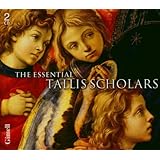
The Essential Tallis Scholars - The Tallis Scholars

The Essential Tallis Scholars
The Tallis Scholars
Gimell CDGIM201

Classics Today rating: 10/10

Perhaps after nearly 25 years of recordings (and an amazing 30 years since the originators of this group gave their first concert at the Church of St Mary Magdalen, Oxford), we've come to take the Tallis Scholars and their special, uniquely identifiable ensemble sound and veracious commitment to renaissance polyphony for granted. But this release--an irresistible two-discs-for-the-price-of-one compilation--reminds us anew just how blessed we are to have enjoyed the benefits of Peter Phillips and his pioneering efforts (and they truly were pioneering back in 1973) in not only rediscovering and restoring but enlivening music from ancient centuries, and showing it to be every bit as exciting and meaningful today as it certainly was in its own time. The fact is, the Tallis Scholars--a group of 10-plus hand-picked singers drawn from Britain's rich pool of highly trained specialists--since its inception has been a leader in the early-music movement and has strongly influenced virtually every important renaissance vocal ensemble to emerge during the last couple of decades.

This ideally-chosen collection taken from the Tallis Scholars' catalog shows a representative range of repertoire and styles--from England, Spain, France, and Italy--and reflects the group's various ensemble configurations. You notice that changes in quality/color of the ensemble sound is more dictated by the character of the composition than by any differences in the group's personnel from year to year or piece to piece. In fact, these selections show how remarkably consistent the group's sound has remained, effectively adjusting to the differences in texture, register relationships and voicing, and aspects of line--from more syllabic to melismatic, and from densely textured Flemish works to more open-spaced English pieces, including the remarkable "high-treble" scoring of Sheppard and Cornysh.

It would be foolish to try to list highlights: everything here is a highlight. Yet it is important to give special mention to such masterful performances as the amazing Allegri Miserere, from the ensemble's first recording (Alison Stamp's treble solo has never been surpassed), Palestrina's Sicut lilium, three gorgeous Lassus pieces, Sheppard's Media vita, the Gloria from Brumel's Missa Et ecce terrae motus, the gentle and lovely song Ah, Robin by William Cornysh the Younger, and the stunningly brilliant Salve regina by his father. The set concludes with a performance of Byrd's five-part Mass that's as close to definitive as we can expect. In fact, that's the case with everything you hear on these CDs. No matter how experienced you are as a listener (or performer), you can't help but marvel at the exceptional standard of vocalism, musicianship, ensemble unity, and collective understanding of style and the ability to convey it in a coherent, aurally and emotionally engaging manner. Taken all together, this set represents the highest achievement in modern performance of renaissance vocal music--not to mention the demonstration-quality sound--and presents it in all of its vibrant, joyful, meditative, sensuous, and compelling glory. Full texts and translations are included in a very classy package. If I had to choose just one recording to demonstrate the radiance, richness, and sheer beauty of renaissance vocal music, this would be it. [8/16/2003]

David Vernier, ClassicsToday.com